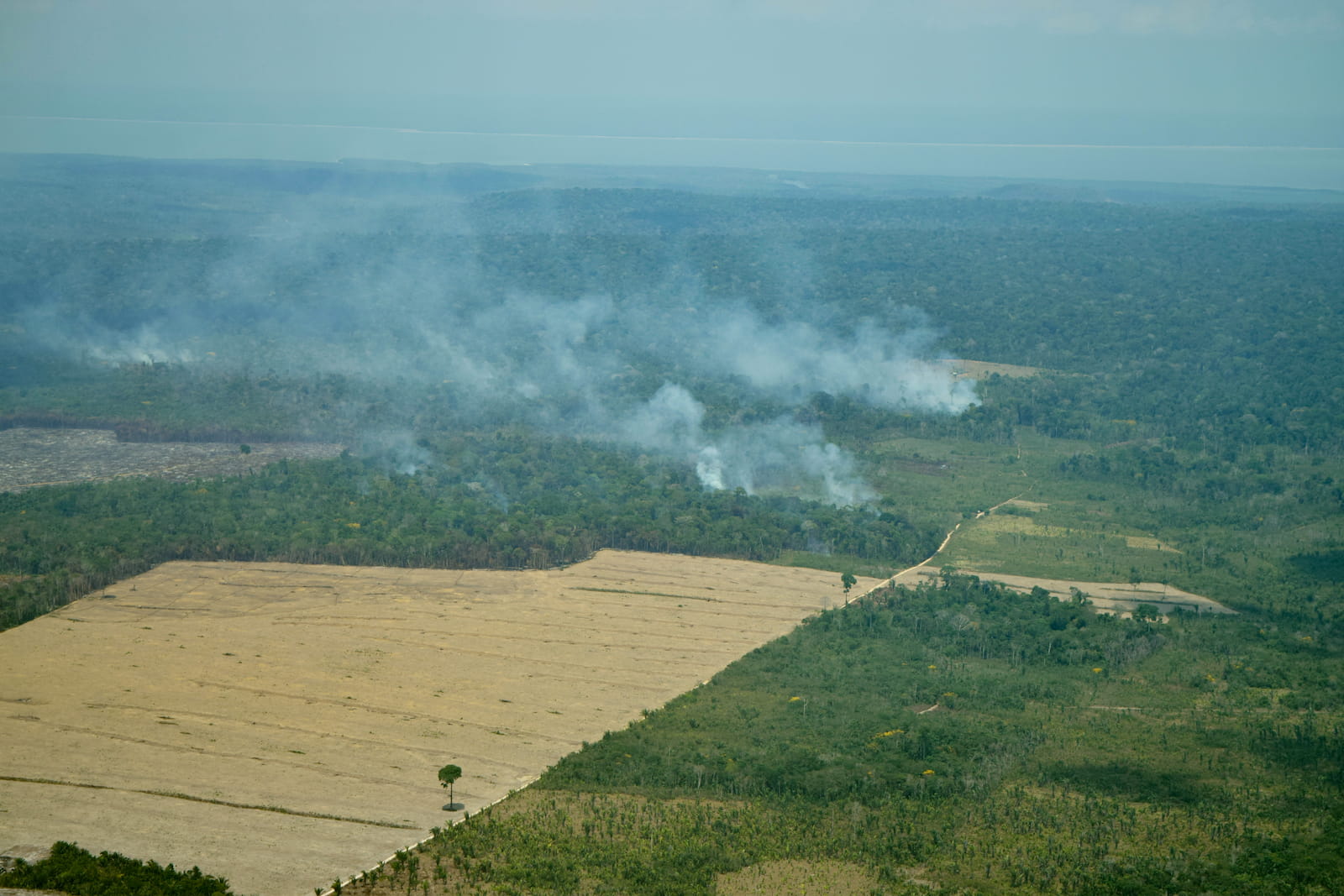
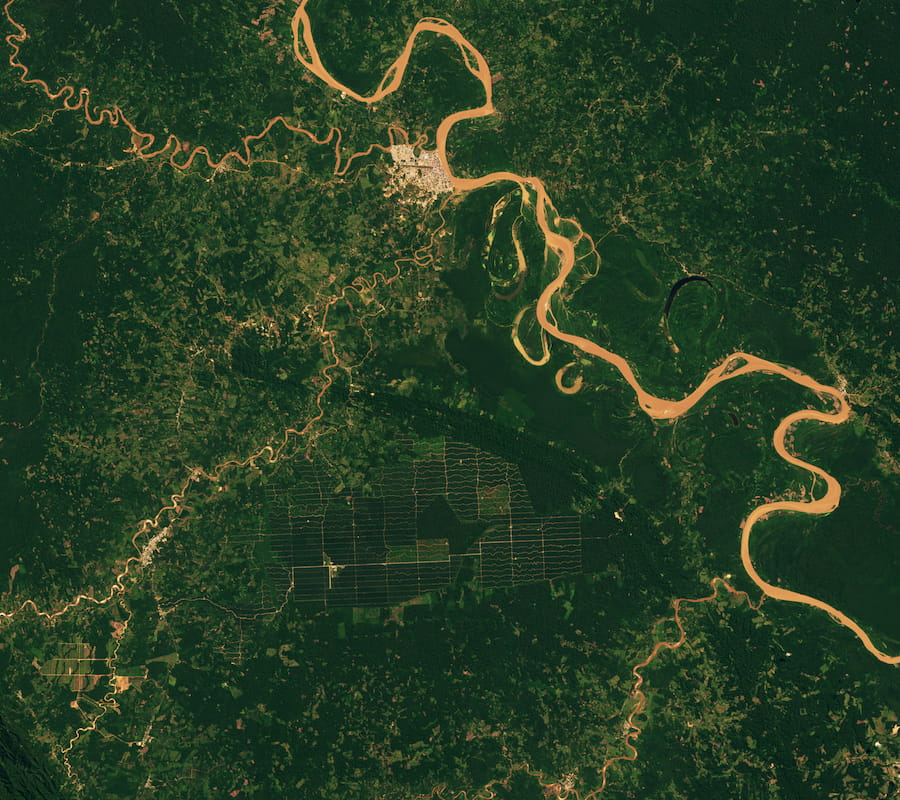
This is not a distant environmental concern. It is one of the most consequential acts of environmental destruction in human history and it's happening right now. Every single day.
Hectares cleared since you opened this page
0.00
hectares of Amazon primary forest
— football fields
Based on the 10-year average primary forest loss (2015–2024): ~2.6M ha/year. All causes: deforestation and fire. Source: GFW/UMD via MAAP. Consistent with Run Forest Run visualisation data.
↓ The evidence ↓
The Consequences of Collapse
If the Amazon Falls
The following are not predictions. They are the documented conclusions of peer-reviewed science.
01
The climate becomes uncontrollable.
Over 200 billion tonnes of CO₂ locked in the Amazon's trees and soil would be released. Every climate target set by every government on Earth becomes mathematically unreachable. Not difficult. Unreachable. — Dr. Carlos Nobre, University of São Paulo
02
South America's water system fails. Permanently.
The Amazon generates its own rainfall and distributes it across a continent via invisible atmospheric rivers. Collapse means permanent drought — not a bad season, not a decade of difficulty. Permanent. The agricultural regions that feed hundreds of millions of people dry out and do not recover. — Nature, February 2024; Science Panel for the Amazon, 2025
03
The sixth mass extinction accelerates beyond any point of return.
One in ten of all species on Earth lives here. When the forest goes, they go. Not eventually. Immediately. Most will vanish before science has named them. — IUCN; INPA (Brazil's National Institute for Amazon Research)
04
Global temperatures rise faster than any model has prepared us for.
The Amazon cools its surrounding region through evapotranspiration. Collapse replaces forest canopy with savannah, raising local temperatures by an estimated 3–5°C, feeding directly back into global warming. A regional event with no regional boundary. — PNAS, December 2025 (doi:10.1073/pnas.2418813122); Nature, May 2026 — tipping point now projected as early as the 2040s at just 1.5–1.9°C of warming
05
The global food system fractures.
Brazil is the world's largest exporter of soy, beef, coffee, sugar and chicken — all dependent on Amazon-regulated rainfall. Permanent drought collapses that output. Food prices rise on every continent. Supply chains built over decades fail in years. — FAO; Brazilian Ministry of Agriculture
06
A quarter of all medicine disappears before it is found.
25% of Western pharmaceuticals originate from rainforest plants. The Amazon's pharmacopoeia is less than 1% explored. Cancer treatments, antivirals, compounds we do not yet know we need — gone before they are discovered. — WHO; National Cancer Institute; Royal Botanic Gardens, Kew
07
Tens of millions of people are displaced.
Unliveable temperatures and crop failure across Brazil, Bolivia, Peru and neighbouring countries would trigger one of the largest climate displacement events in recorded history. People do not stay where there is no water. — UNHCR climate displacement modelling; Science Panel for the Amazon, 2025
08
Other planetary tipping points fall.
Scientists identify the Amazon as one of several interconnected planetary systems. Its collapse accelerates Arctic permafrost thaw, threatens the West Antarctic ice sheet, and disrupts the West African monsoon. The Amazon is not one domino. It is the first. — Lenton et al., Nature, 2019; Potsdam Institute for Climate Impact Research
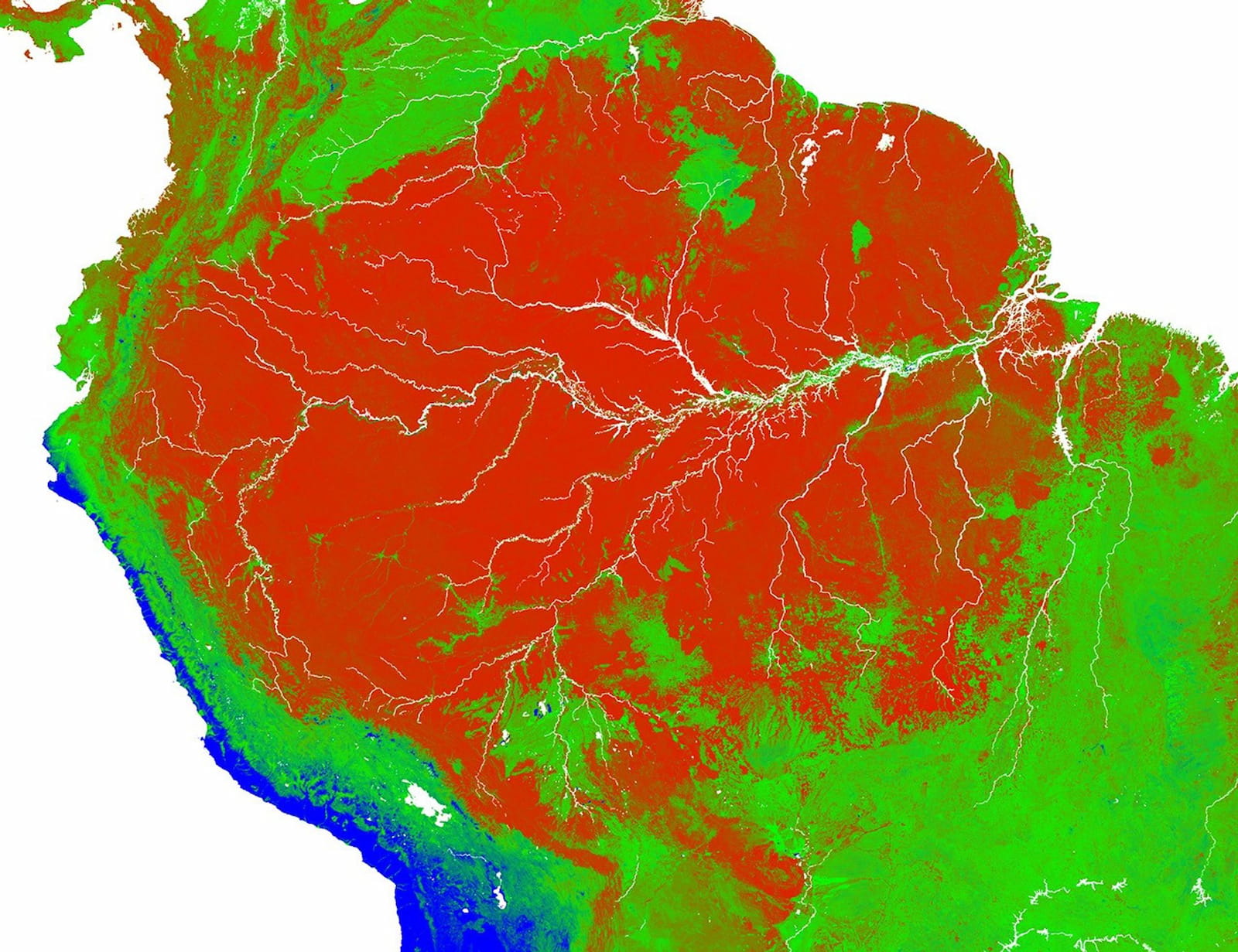
The "Arc of Deforestation" — the southeastern edge of the Amazon, imaged by NASA's MODIS satellite. Red is intact forest. Green and blue are cleared land. The fishbone pattern radiating from roads is the signature of the frontier advancing. NASA Earth Observatory
01 — The Scale
A Forest Larger Than Western Europe. Disappearing.
The Amazon covers approximately 6 million km² of rainforest across nine countries. It is not a forest — it is a planetary system. Home to 10% of all species on Earth. Generator of 20% of the world's freshwater discharge. A living machine that recycles its own rainfall and pumps moisture across a continent.
Since 1970, an estimated 971,160 km² of primary forest has been razed. That is an area nearly the size of Egypt. In 2024 alone, 4.5 million hectares of primary forest were lost to deforestation and fire combined — including a record-breaking 2.8 million hectares destroyed by fire, shattering the previous record by 65%.
~18%
of Amazon lost since 1970 to deforestation
38%
of remaining forest is degraded or fragmented — in addition to what has been cleared. Source: Lapola et al., Science, 2023.
4.5M
hectares of primary forest lost in 2024 alone
+92%
increase in deforestation, May 2024 to May 2025
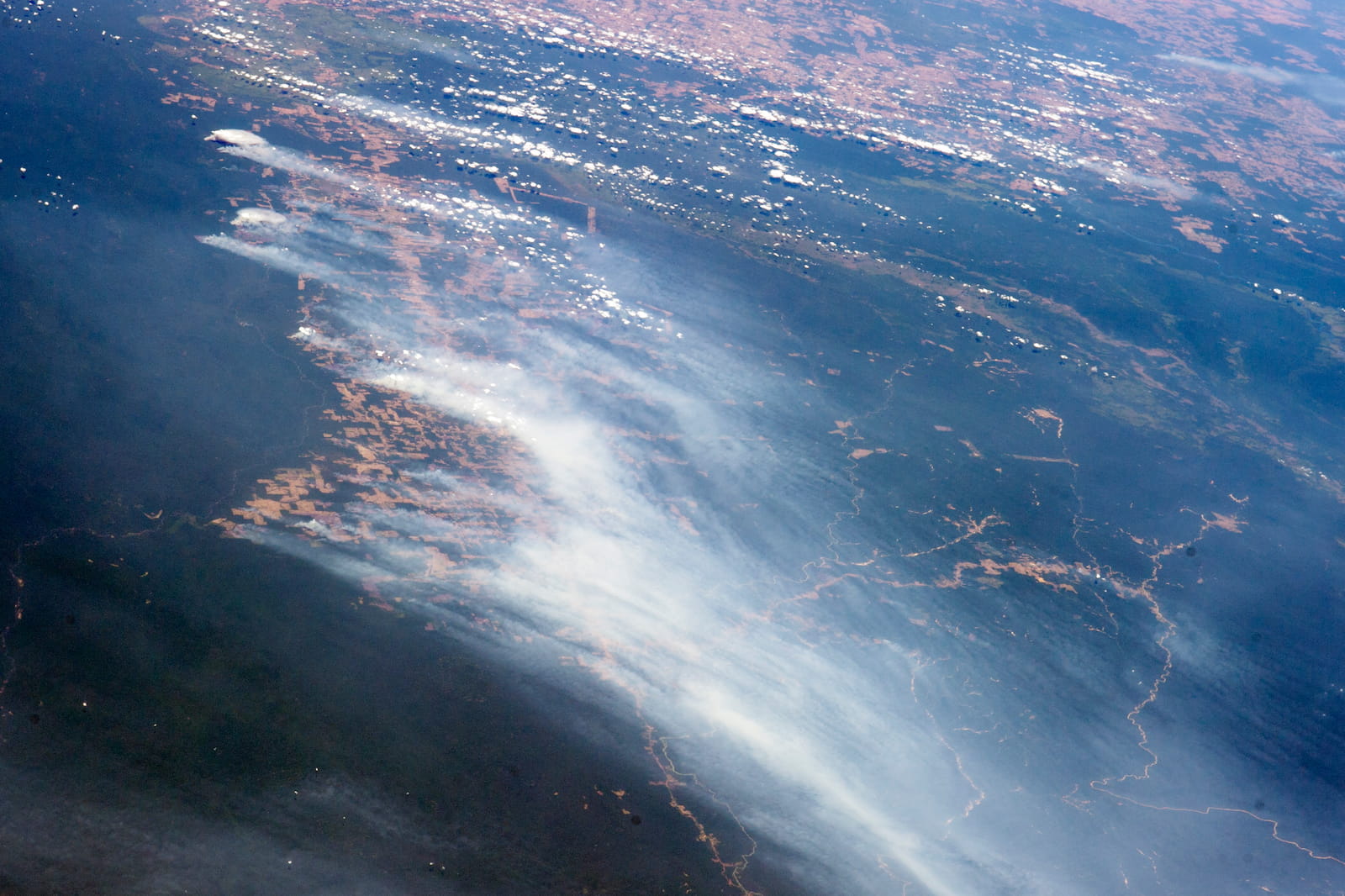
Fires burn along highway BR-163 in Mato Grosso/Pará, Brazil, clearing forest for agriculture — photographed from the International Space Station. NASA Earth Observatory
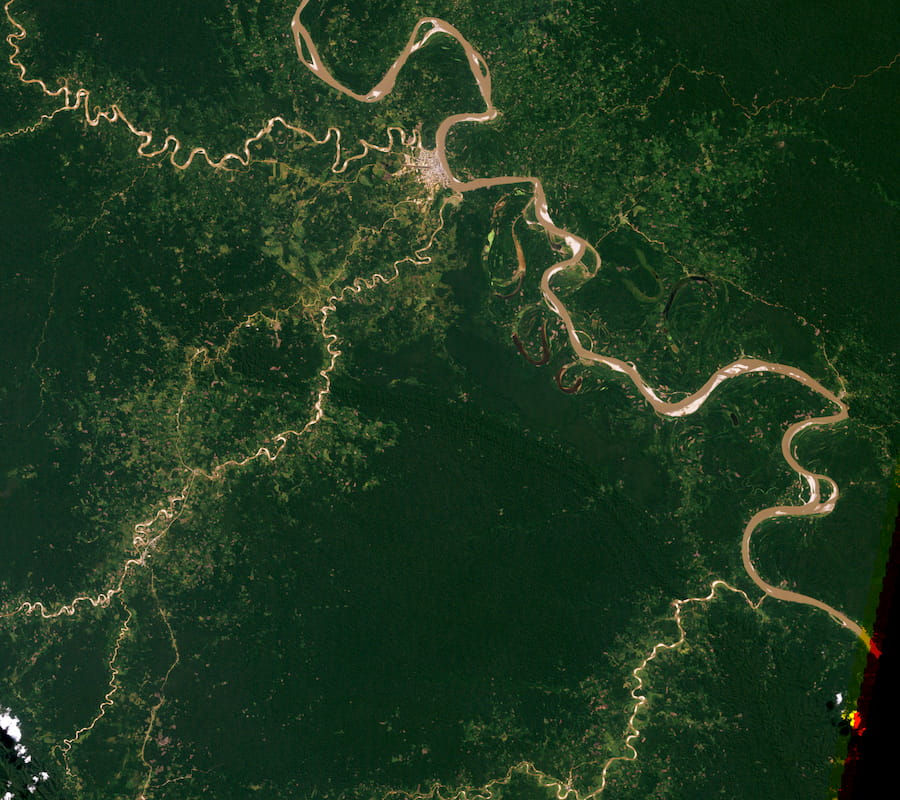
2001
2019
Yurimaguas, Peru — 18 years apart. The dense green of intact rainforest gives way to the fishbone pattern of roads and clearings, the most common signature of Amazon deforestation. NASA Earth Observatory, Landsat 7 / Landsat 8
The driver is not mystery. 80% of deforestation is for cattle pasture and soy — but the mechanics are more entangled than they appear, and more damning for all of us.
Beef is the primary direct driver — responsible for the majority of clearcut. But over 60% of Amazon beef is consumed domestically within Brazil, not exported. This is not a story of Europe or China eating the forest. It is a story of a domestic food system with no mechanism to price the cost of what it destroys.
Soy is more complex. In 2006, the Amazon Soy Moratorium — a voluntary commitment by over 25 trading companies including Cargill, Bunge and Louis Dreyfus — banned the purchase of soy from land deforested after 2008. It worked. Before the moratorium, 30% of soy expansion meant deforestation. By 2013 that figure had fallen to 1%. From 2006 to 2023, 97.6% of Amazon deforestation had no direct soy link, even as soy area grew fourfold. Brazil became the world's largest soy exporter — 127 million tonnes exported in 2023, generating $53 billion — without directly clearing primary forest to do it.
But soy deforests indirectly. Investors buy land cleared by cattle ranchers — technically "clean" under the moratorium — and the ranchers take the money and clear further in. Soy also builds the roads, raises the land values, and funds the infrastructure that opens the frontier. And in August 2025, Brazil's antitrust regulator suspended the moratorium entirely, ruling it an anti-competitive cartel. The agreement that protected the Amazon for 19 years and saved an estimated 1.8 million hectares is now dismantled — just months before COP30, hosted by Brazil. China, which buys 80% of Brazil's soy and is bound by no equivalent agreement, has every economic incentive to fill the gap. The era of soy as a clean crop in the Amazon is over.
02 — What Is Being Lost
Species That Will Not Return
The Amazon contains more biodiversity than anywhere on Earth — an estimated 3 million species, the majority still unknown to science. When a tract of primary forest falls, it does not just remove trees. It erases species found nowhere else. Many will vanish before they are ever named.
The IUCN Red List currently classifies 10,774 species as critically endangered globally — the last category before extinct in the wild. The Amazon, as home to roughly 10% of all species on Earth, bears a proportionate share of that crisis. Of the amphibian species assessed in the Amazon alone, approximately 18% face extinction risk. The rate of loss is not linear — science has identified a threshold beyond which collapse accelerates catastrophically.
Amazonian Jaguar
Apex predator. Fewer than 15,000 remain in the wild. Habitat fragmentation prevents the territory needed to sustain viable populations.
Vulnerable
Amazon River Dolphin (Boto)
Freshwater dolphin endemic to Amazonian rivers. Threatened by mercury contamination from illegal gold mining and river degradation from deforestation.
Endangered
Giant Anteater
Critical ecological role in controlling insect populations. Road kills and habitat loss from agricultural expansion have accelerated decline.
Vulnerable
Hyacinth Macaw
The world's largest flying parrot. Dependent on ancient Brazil nut trees that take decades to mature — trees that cannot be replaced once cleared.
Endangered
Giant River Otter
Listed as endangered. River system degradation from deforestation, sedimentation and mercury from mining has collapsed prey populations.
Endangered
Uakari Monkey
Entirely dependent on flooded várzea forests. As deforestation fragments habitat, isolated populations cannot sustain genetic viability.
Vulnerable
Thousands of unnamed species
Scientists estimate that for every hectare of primary Amazon forest cleared, an unknown number of invertebrate, plant, fungal and microbial species are permanently erased — species that science has not yet described.
Unknown
The Amazon holds an estimated 3 million species. Science has formally described fewer than 20% of them. Every hectare of primary forest cleared erases species that will never be named, studied, or understood — knowledge lost before it existed.
— IUCN / INPA (Brazil's National Institute for Amazon Research)
03 — The Threshold
We Are Standing at the Edge
Scientists do not use the word "tipping point" lightly. In the Amazon, it has a precise meaning: the moment at which deforestation triggers self-reinforcing collapse — where the forest can no longer generate the rainfall needed to sustain itself, dries out, catches fire, and transitions permanently into dry savannah. Savannization. Irreversible.
The threshold is estimated at 20–25% total forest loss, combined with global warming beyond 2°C. We are currently at approximately 17–18% deforestation and accelerating. The southeastern Amazon has already crossed its own local tipping point — it is now a net carbon emitter, not a sink.
Deforestation progress toward tipping point (0–25% scale)
25% — Point of No Return
~17–18% Now
0%▲ ~17–18% We are here25% — Tipping Point
75%
of the Amazon has been losing resilience since the early 2000s — Nature Climate Change
47%
of forest area could undergo ecosystem transitions by 2050 — Science Panel for the Amazon 2025
200Gt
CO₂ released if tipping point triggered — 5 years of global emissions
2050
the year Dr. Carlos Nobre estimates the tipping point could be reached at current trajectory
"The Amazon is very close to a tipping point. That would induce a self-degradation of 50% to 70% of the forest, releasing more than 200 billion tonnes of CO₂ into the atmosphere."
— Dr. Carlos Nobre, Earth System Scientist, University of São Paulo
04 — The Global Water Machine
The Amazon Does Not Just Grow Rain. It Sends It.
The Amazon is the centre of the global water cycle. The forest recycles 30–50% of its own rainfall through transpiration — trees release water vapour that forms clouds that return as rain. This creates "flying rivers": invisible atmospheric rivers of moisture that carry more water than the Amazon River itself, distributing precipitation across South America and beyond.
What flying rivers supply
▸
Southern Brazil — which generates ~70% of the country's economic output — would be arid desert without the flying rivers, according to climate scientist Antonio Nobre. The agricultural regions producing Brazil's soy, beef, coffee and corn depend entirely on this invisible infrastructure.
▸
Complete Amazon deforestation could reduce Sierra Nevada snowpack by up to 50%, according to modelling by Princeton University published in the Journal of Climate. The Amazon's moisture systems are not contained to South America — they reach the atmosphere and travel.
▸
Hydropower generation across Brazil — which supplies 65% of Brazil's electricity — is directly dependent on river flows fed by Amazon rainfall. Deforestation is already degrading output.
▸
The dry season is already 4–5 weeks longer across eastern and southern Amazon than it was in 1979. Temperatures in the southeastern arc are 3.1°C higher during dry months. The system is changing now.
The forest is worth an estimated $20 billion annually in rainfall generation alone. This is not counted in any commodity price. Not in a soy futures contract. Not in a cattle invoice. The Amazon gives this away for free — and we are destroying the infrastructure.
05 — Carbon Sink Becoming Source
The Lungs Have Started Exhaling
For decades, the Amazon absorbed more carbon dioxide than it emitted — a vital brake on global warming. In the 1980s and 90s, the forest was removing more than 1.5 billion tonnes of CO₂ per year from the atmosphere. That function is collapsing.
In 2021, a landmark nine-year NOAA study published in Nature confirmed what scientists had feared: the southeastern Amazon is now a net carbon emitter. The region that once absorbed carbon is now releasing it. Fire burning emits three times more CO₂ than the surviving forest can absorb.
The carbon math of tipping point collapse is staggering. Dieback of just 50% of the Amazon — 263 million hectares — would release 131.5 gigatons of carbon. The equivalent of approximately 25 years of US CO₂ emissions. In a single ecological event.
1.5Bt
tonnes CO₂ absorbed per year by Amazon in 1990s
↓ ~80%
estimated reduction in net carbon absorption since the 1990s — Dr. Carlos Nobre, University of São Paulo. The Amazon now removes "several hundred million tonnes" where it once removed 1.5 billion.
131Gt
CO₂ released if half the Amazon collapses — approximately 25 years of US emissions
340Mt
CO₂ removed annually by Indigenous-managed Amazon lands — the only areas still functioning as sinks
06 — The Economics of Destruction
The Worst Trade in Human History
The economic case for deforestation is built on a fiction: that the forest has no value. In reality, it is the most valuable piece of infrastructure on Earth — and we are selling it for $1.33 per ton of the carbon it stores.
Cost to clear one hectare
$300–600
What a farmer pays to clear one hectare of Amazon primary forest. The timber sold from that hectare returns an average of just $4. The land itself is the point — a speculative asset, not a productive one. Source: The Nature Conservancy / ScienceDirect 2025.
Carbon stored in one hectare
500t CO₂
The average Amazon hectare holds 150 tonnes of carbon. When burned, that releases approximately 500 tonnes of CO₂ — carbon that took centuries to accumulate, released in days. Source: INPE emissions modelling.
Cost to prevent 1 tonne CO₂
$1.33
Halting Amazon deforestation is the cheapest large-scale climate intervention available — cheaper than solar subsidies, cheaper than electric vehicle incentives, cheaper than almost any alternative. Source: Woodwell Climate Research Center (formerly Woods Hole Research Institute).
Soil productivity after clearing
5–10 yrs
Amazon soils are among the poorest on Earth for agriculture. Nutrients are locked in the living forest, not the ground. Once cleared and farmed, most land is exhausted within a decade — then abandoned, as the frontier moves deeper.
This is the central absurdity: a farmer spends $300–$600 to clear a hectare, earns $4 from the timber, farms degraded soil for a few years, then abandons it and clears again. The forest — which took centuries to build, stores 500 tonnes of CO₂, generates its own rainfall, and sustains thousands of species — is destroyed for a transaction that would not cover a week's wages. The economics only work because the forest's true value is never on the invoice.
07 — What It Means for Humanity
This Is Not an Environmental Story. It Is a Human One.
Over 400 Indigenous groups — representing some of the oldest living cultures on Earth — call the Amazon home. Many have never had contact with the outside world. As their forest disappears, so do their languages, their knowledge systems, their medicines. Accumulated over thousands of years. Gone in a dry season.
But the consequences reach every human alive. The Amazon regulates global temperature. It generates rainfall across two continents. It stores the carbon of centuries. If it tips — and the science says we are close — the climate feedback loops it triggers will accelerate warming worldwide, disrupt food systems from California to sub-Saharan Africa, and render hundreds of millions of people food and water insecure within a generation.
NASA identifies the Amazon as the centre of the global water cycle. Its destruction does not stay in Brazil. It arrives in drought. In crop failure. In displaced people. In the slow unravelling of the stable climate that agriculture — and civilisation — depends on.
The window is still open. In 2023, deforestation fell 49% in Brazil following political change and enforcement — proof that the trajectory can reverse. Indigenous-managed Amazon lands removed 340 million tonnes of CO₂ annually between 2001 and 2021 — the equivalent of taking approximately 74 million cars off the road every year, and proof that the forest, when protected, still functions. The science is clear: halt deforestation now and the tipping point can be avoided. The choice is still ours. Barely. And not for much longer.
08 — There Is One Thing That Works
Buy the Land. Put Rangers on It.
While governments negotiate and corporations make pledges, a small team on the Las Piedras River in Peru's Madre de Dios region is doing something simpler. Junglekeepers buys the land. Then they put rangers on it.
The model is almost disarmingly straightforward: 60 cents of every donated dollar goes to direct land acquisition — the only guaranteed form of protection. 34 cents funds the ranger programme that patrols those boundaries. Within the land they currently hold — 138,000 acres — incidents of illegal logging have dropped by over 90%. Illegal land acquisition has fallen to near zero.
They need to protect another 170,000 acres immediately. The gap between what they hold and what needs protecting is, at its core, a funding problem. The forest is there. The rangers are trained. The model is proven. What's missing is money.
INPE/PRODES — Brazil's National Institute for Space Research, PRODES programme. Measures primary forest loss in the Brazilian Legal Amazon using annual Landsat satellite imagery. The gold standard for Brazilian Amazon deforestation data, produced by the Brazilian government and peer-reviewed internationally. Covers clear-cut deforestation only — does not include fire-driven loss or degradation. Available via TerraBrasilis.
Annual Forest Loss
2002 – 2025
GFW/UMD Primary Forest Loss — Global Forest Watch, powered by the University of Maryland's Global Land Analysis and Discovery (GLAD) laboratory. Measures annual primary forest loss across the full Amazon biome covering nine countries, all causes including deforestation and fire. Updated annually, typically released mid-year for the previous calendar year. Queried directly from the GFW Data API v1.9.1 via geostore d44bb24653ce755b02a2bacf49223e41.
Daily Clearing Figure
Live · Updated hourly
GFW Integrated Deforestation Alerts — a composite of four independent satellite alert systems: GLAD-L (Landsat 8/9, optical), GLAD-S2 (Sentinel-2, optical), RADD (Sentinel-1, radar), and DIST-ALERT (global vegetation disturbance). Run Forest Run queries the GFW Data API for the total alert area across the Amazon biome over the preceding 30 days and divides by 30 to produce a daily average. Radar-based systems (RADD) can detect through cloud cover; optical systems require clear skies. Combined lag between a deforestation event occurring on the ground and appearing in the alert dataset is typically 2–16 days depending on cloud cover, satellite pass frequency, and confidence threshold. Results are cached hourly. When the live API is unavailable, Run Forest Run falls back to the 2025 annual UMD average of 21,957 km²/year ÷ 365.
Page Counter
Hectares since page load
The live counter on this page uses the 10-year average primary forest loss (2015–2024) across the Amazon biome: approximately 2.6 million hectares per year, all causes. This equals roughly 0.082 hectares per second. The figure is derived from MAAP annual reports compiled from GFW/UMD data, and is consistent with the methodology used throughout the Run Forest Run visualisation. It is intentionally conservative — 2024 was an anomalous record year at 4.5 million hectares; using the 10-year average avoids overstating a single extreme year.
Editorial Sources
Facts page citations
Statistics and claims throughout The Reckoning are sourced from peer-reviewed literature and government data including: INPE · GFW/UMD · NOAA · Nature · Nature Climate Change · Science (Lapola et al., 2023) · Science Panel for the Amazon 2025 · PNAS · Potsdam Institute for Climate Impact Research · WHO · National Cancer Institute · Royal Botanic Gardens Kew · FAO · World Resources Institute · IUCN · INPA · MAAP · Woods Hole Research Institute · FUNAI. Individual citations are noted inline throughout the page.